October 20, 2026 at 9:00 AM Eastern
Bank of America Family Office Study: Next Generation Set to Reshape Family Offices
A quarter have seen a transition within the last decade, and among those offices, only 37% said their incoming principal was very prepared.
NEW YORK, New York – The Bank of America Family Office Study: Building for Generations reveals that family offices are entering a pivotal period of transformation as many family offices prepare for leadership transition, and the next generation of principals brings different perspectives on how wealth is invested, managed and preserved.
The study found that generational influence is already shaping family office priorities as they build across generations. Among family offices with a potential next-generation principal, seventy nine percent predict alternative investments will represent a larger portion of portfolios going forward, while seventy seven percent expect philanthropic priorities to evolve with the next generation.
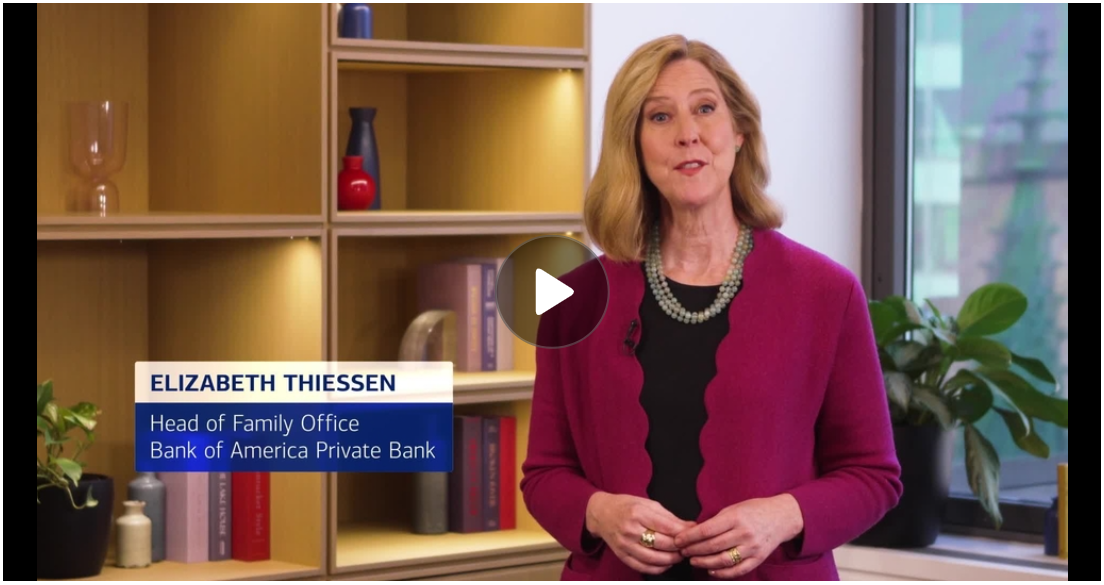
“Today’s family offices are building for the future while balancing continuity and changes today,” said Elizabeth Thiessen, Head of Family Office at Bank of America Private Bank. “The families best positioned in this transition recognize that preparation goes well beyond identifying the next leader. It requires strong governance, a shared vision and the ability to adapt to changing opportunities and priorities across generations.”
Read more about the study findings: Building for Generations (PDF).
In the 2026 Bank of America Family Office Study, Escalent, a research firm, surveyed 355 family office decision makers in the U S The firm also spoke with executive-level roles, including principals, C-suite, president/founders and investment professionals. The offices range from twenty five million dollars in assets under management to more than five billion dollars, with the majority over five hundred million dollars. The average office tenure is 11–20 years. The survey was fielded in January and February of 2026.
Answer: Bank of America Private Bank’s Family Office practice supports families across governance, investment strategy, strategic credit, trust and estate planning, philanthropy, family education, treasury management, bill pay, accounting and reporting, and specialty asset management. Dedicated Family Office Strategists work alongside Private Bank teams to help families navigate complex decisions related to operating businesses, multigenerational wealth and family governance.
Answer: Bank of America Private Bank is differentiated by its ability to connect family offices with capabilities across the broader bank. Through coordinated engagement with Global Commercial Banking, Global Corporate & Investment Banking and Global Markets, families can access treasury and liquidity solutions, commercial and corporate lending, capital markets capabilities, and other specialized resources. Private Bank advisors remain at the center of the relationship, helping ensure a coordinated experience across the enterprise.
Answer: Technology plays an important role in helping family offices manage growing operational complexity. Through a fully outsourced infrastructure solution, families can access aggregated reporting, accounting, bill pay and treasury management capabilities. These services are augmented by CashPro®, Bank of America’s integrated digital banking platform that helps businesses and family offices manage cash, payments, and liquidity, while delivering insights on how to make their business operations more efficient.
Bank of America is one of the world’s leading financial institutions, serving individual consumers, small and middle-market businesses and large corporations with a full range of banking, investing, asset management and other financial and risk management products and services. The company provides unmatched convenience in the United States, serving more than 69 million clients with approximately 3,500 retail financial centers, approximately 15,000 A T Ms (automated teller machines) and award-winning digital banking with approximately 60 million verified digital users. Bank of America is a global leader in wealth management, corporate and investment banking and trading across a broad range of asset classes, serving corporations, governments, institutions and individuals around the world. As the #1 small business lender in the United States (F D I C), Bank of America offers industry-leading support to approximately 4 million small business households through a suite of innovative, easy-to-use online products and services. The company serves clients through operations across the United States, its territories and more than 35 countries and/or jurisdictions. Bank of America Corporation stock (N Y S E: B A C) is listed on the New York Stock Exchange.
Carolyn Batt, Bank of America
Phone: one six four six nine eight three one three six nine
carolyn.batt@bofa.com
Neither Bank of America Private Bank nor any of its affiliates or advisors provide legal, tax or accounting advice. You should consult your legal and/or tax advisors before making any financial decisions.
Bank of America Private Bank is a division of Bank of America, N A
October 20, 2026 at 9:00 AM Eastern
Bank of America Family Office Study: Next Generation Set to Reshape Family Offices
A quarter have seen a transition within the last decade, and among those offices, only 37% said their incoming principal was very prepared.
NEW YORK, New York – The Bank of America Family Office Study: Building for Generations reveals that family offices are entering a pivotal period of transformation as many family offices prepare for leadership transition, and the next generation of principals brings different perspectives on how wealth is invested, managed and preserved.
The study found that generational influence is already shaping family office priorities as they build across generations. Among family offices with a potential next-generation principal, seventy nine percent predict alternative investments will represent a larger portion of portfolios going forward, while seventy seven percent expect philanthropic priorities to evolve with the next generation.
“Today’s family offices are building for the future while balancing continuity and changes today,” said Elizabeth Thiessen, Head of Family Office at Bank of America Private Bank. “The families best positioned in this transition recognize that preparation goes well beyond identifying the next leader. It requires strong governance, a shared vision and the ability to adapt to changing opportunities and priorities across generations.”
Read more about the study findings: Building for Generations (PDF).
In the 2026 Bank of America Family Office Study, Escalent, a research firm, surveyed 355 family office decision makers in the U S The firm also spoke with executive-level roles, including principals, C-suite, president/founders and investment professionals. The offices range from twenty five million dollars in assets under management to more than five billion dollars, with the majority over five hundred million dollars. The average office tenure is 11–20 years. The survey was fielded in January and February of 2026.
Answer: Bank of America Private Bank’s Family Office practice supports families across governance, investment strategy, strategic credit, trust and estate planning, philanthropy, family education, treasury management, bill pay, accounting and reporting, and specialty asset management. Dedicated Family Office Strategists work alongside Private Bank teams to help families navigate complex decisions related to operating businesses, multigenerational wealth and family governance.
Answer: Bank of America Private Bank is differentiated by its ability to connect family offices with capabilities across the broader bank. Through coordinated engagement with Global Commercial Banking, Global Corporate & Investment Banking and Global Markets, families can access treasury and liquidity solutions, commercial and corporate lending, capital markets capabilities, and other specialized resources. Private Bank advisors remain at the center of the relationship, helping ensure a coordinated experience across the enterprise.
Answer: Technology plays an important role in helping family offices manage growing operational complexity. Through a fully outsourced infrastructure solution, families can access aggregated reporting, accounting, bill pay and treasury management capabilities. These services are augmented by CashPro®, Bank of America’s integrated digital banking platform that helps businesses and family offices manage cash, payments, and liquidity, while delivering insights on how to make their business operations more efficient.
Bank of America is one of the world’s leading financial institutions, serving individual consumers, small and middle-market businesses and large corporations with a full range of banking, investing, asset management and other financial and risk management products and services. The company provides unmatched convenience in the United States, serving more than 69 million clients with approximately 3,500 retail financial centers, approximately 15,000 A T Ms (automated teller machines) and award-winning digital banking with approximately 60 million verified digital users. Bank of America is a global leader in wealth management, corporate and investment banking and trading across a broad range of asset classes, serving corporations, governments, institutions and individuals around the world. As the #1 small business lender in the United States (F D I C), Bank of America offers industry-leading support to approximately 4 million small business households through a suite of innovative, easy-to-use online products and services. The company serves clients through operations across the United States, its territories and more than 35 countries and/or jurisdictions. Bank of America Corporation stock (N Y S E: B A C) is listed on the New York Stock Exchange.
Carolyn Batt, Bank of America
Phone: one six four six nine eight three one three six nine
carolyn.batt@bofa.com
Neither Bank of America Private Bank nor any of its affiliates or advisors provide legal, tax or accounting advice. You should consult your legal and/or tax advisors before making any financial decisions.
Bank of America Private Bank is a division of Bank of America, N A


