October 29, 2026 at 9:00 AM Eastern
Bank of America Study: Early December Could Overtake Black Friday as the Peak Holiday Shopping Window This Year
twenty nine percentof Americans say they plan to do most of their shopping in early to mid-December this holiday season, compared with seventeen percent on Black Friday
CHARLOTTE, North Carolina – Black Friday traditionally marks the unofficial start of the holiday shopping season, however this year consumers are planning to make their biggest holiday shopping push a little later. According to the Bank of America 2026 Holiday Spending Survey (PDF), twenty nine percent of consumers plan to do most of their holiday shopping in early to mid December, up from nineteen percent in 2025. Meanwhile, those planning to concentrate most of their shopping around Black Friday fell from twenty five percent to seventeen percent.
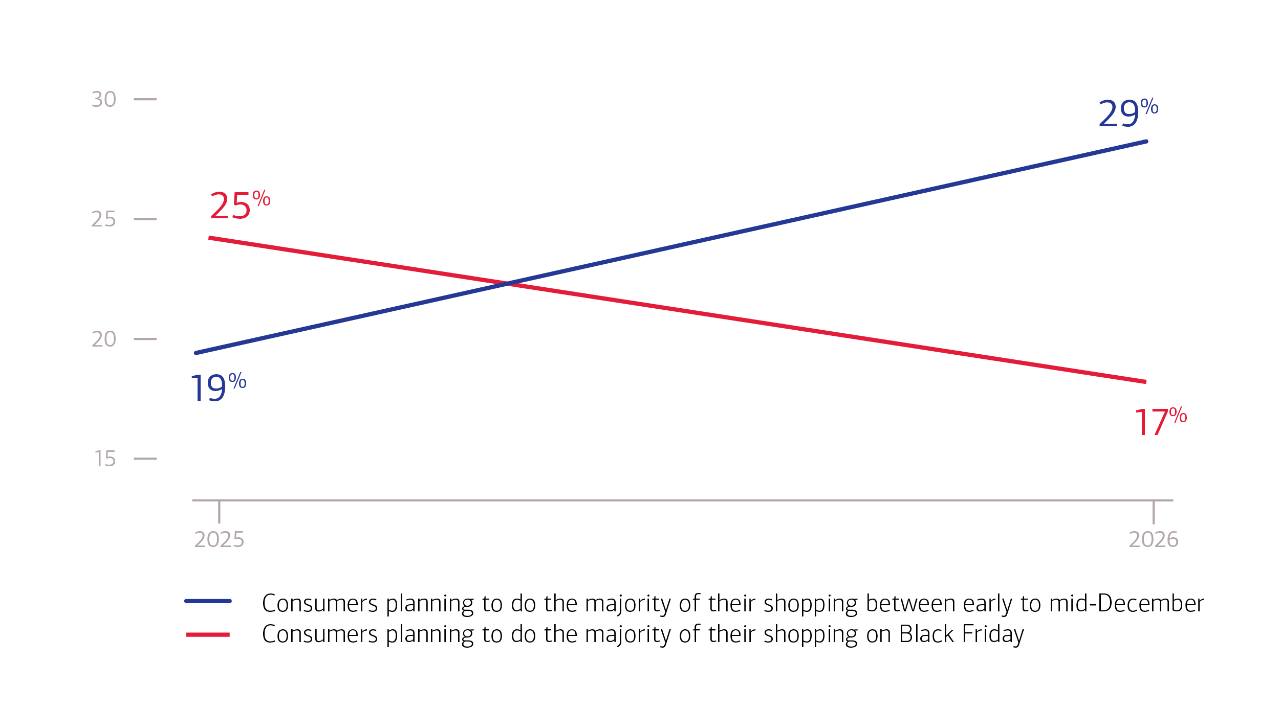
This line graph compares two groups of consumers in 2025 and 2026. The vertical axis shows the percentage of consumers, from fifteen percent to thirty percent. The horizontal axis shows the years 2025 and 2026.
The two lines cross between 2025 and 2026. In 2026, early to mid-December overtakes Black Friday as the more popular time for consumers to do most of their holiday shopping.
Fewer than two out of five (thirty eight percent) consumers said they have shopped or will shop earlier in 2026, down from fifty two percent in 2025. However, sentiment is running cooler than spending — Bank of America Institute's latest Consumer Checkpoint shows holiday spending is already increasing at a solid rate through September.
“Consumers are being more deliberate this year, from setting their own timelines to staying focused on their budgets,” said Mary Hines Droesch, Head of Consumer and Small Business Products and Analytics at Bank of America. “At the same time, our Bank of America spending data shows the season is off to a healthy start.”
Nearly half of consumers (forty eight percent) expect to spend about the same this holiday season as last year – up from thirty nine percent in 2025, with thirty nine percent also saying they will spend less on holiday gifts this year – down from forty two percent in 2025. Meanwhile, only twelve percent plan to spend more, down from nineteen percent last year. Nearly two thirds (sixty three percent) base holiday spending strictly on their own budget rather than what friends or family spend, rising to seventy eight percent of baby boomers.
Consumers’ top strategies for avoiding overspending include:
E commerce remains the most common way to shop (seventy four percent), while fifty four percent still plan to visit brick and mortar stores. Overall, consumers are more selective about newer tools:
thirty seven percent of consumers say they have encountered at least one holiday shopping scam tactic in recent years. The most common scams they see include:
In addition, Gen X and baby boomers are more than twice as likely as Gen Z to report retailer phishing attempts.
Credit cards are the preferred holiday payment method (over debit cards, cash or Buy Now, Pay Later) for forty nine percent of consumers, up from thirty two percent in 2025. The preference is particularly pronounced among higher income Americans, sixty seven percent of whom favor credit cards, compared with twenty four percent of lower income consumers.
The shift toward credit cards is also strongest among older consumers, while younger shoppers continue to rely more heavily on debit cards for holiday purchases, with thirty three percent of millennials and thirty eight percent of Gen Z citing it as their preferred method.
Answer: A little extra caution can go a long way. Holiday scams often look like messages you've seen before, including emails that appear to be from retailers, fake shipping or delivery notifications and requests for personal information. These messages often create a false sense of urgency, pressuring you to act immediately. If you receive an unexpected message or notification and something doesn't seem right, don't click on any links. Instead, go directly to the retailer's website or shipping carrier's app to verify it. Pause before you click on anything – that extra moment of caution can help protect both your personal information and your holiday budget. You can always check Bank of America Security Center’s Scam Prevention resources for additional tips and tools to stay safe.
Answer: Start with a realistic budget and a spending limit for each person on your list. Compare prices, take advantage of seasonal sales, and consider using credit card rewards, points, or cash back on purchases you already planned to make. Visit Better Money Habits for additional tips for staying on budget and getting the most value from your holiday spending.
Answer: Before shopping, identify your top financial priorities for the season and set spending limits that support those goals. Don't let social pressure or gift expectations drive your spending, and remember that meaningful gifts aren't defined by price. By planning ahead, taking advantage of deals, and practicing a "pause before you pay" mindset before making purchases, you can stay on budget while reducing financial stress after the holidays.
Answer: Start by checking whether retailers offer loyalty points, member discounts, or seasonal promotions on purchases you already plan to make. Then, layer those benefits with rewards from a credit card that aligns with your needs and rewards your spending, such as the Bank of America® Customized Cash Rewards card. Cardholders can earn three percent cash back in a category of their choice each month, making it a smart option for holiday shopping needs. Even better, new cardholders can get a six percent cash back bonus offer in their choice category during the first year. Cash rewards can then be redeemed as statement credits or deposited directly into an eligible Bank of America checking or savings account to help offset costs throughout the year.
This survey was conducted online from September tenth through twelfth, 2026, by Ipsos using the probability based KnowledgePanel®. This study is based on a nationally representative probability sample of 2,062 adults age 18 or older.
The survey was conducted in English and utilized the Ipsos KnowledgePanel®, the original and most well established online probability based panel that is representative of the adult U S population. KnowledgePanel uses address based sampling to randomly recruit U S households, including households without existing internet access.
The margin of sampling error for the total sample is ±2.2 percentage points at the ninety five percent confidence level. The margin of sampling error takes into account the design effect, which was 1.02.
The survey data were weighted to match national population benchmarks for gender by age, race/ethnicity, education, Census region, metropolitan status, and household income. Benchmarks for these variables were obtained from the 2025 March Supplement of the Current Population Survey (C P S).
Bank of America is one of the world’s leading financial institutions, serving individual consumers, small and middle market businesses and large corporations with a full range of banking, investing, asset management and other financial and risk management products and services. The company provides unmatched convenience in the United States, serving more than 69 million clients with approximately 3,500 retail financial centers, approximately 15,000 A T Ms (automated teller machines) and award winning digital banking with approximately 60 million verified digital users. Bank of America is a global leader in wealth management, corporate and investment banking and trading across a broad range of asset classes, serving corporations, governments, institutions and individuals around the world. As the #1 small business lender in the United States (F D I C), Bank of America offers industry leading support to approximately 4 million small business households through a suite of innovative, easy to use online products and services. The company serves clients through operations across the United States, its territories and more than 35 countries and/or jurisdictions. Bank of America Corporation stock (N Y S E B A C) is listed on the New York Stock Exchange.
Don Vecchiarello, Bank of America
Phone: one nine eight zero three eight seven four eight nine nine
don.vecchiarello@bofa.com
October 29, 2026 at 9:00 AM Eastern
Bank of America Study: Early December Could Overtake Black Friday as the Peak Holiday Shopping Window This Year
twenty nine percentof Americans say they plan to do most of their shopping in early to mid-December this holiday season, compared with seventeen percent on Black Friday
CHARLOTTE, North Carolina – Black Friday traditionally marks the unofficial start of the holiday shopping season, however this year consumers are planning to make their biggest holiday shopping push a little later. According to the Bank of America 2026 Holiday Spending Survey (PDF), twenty nine percent of consumers plan to do most of their holiday shopping in early to mid December, up from nineteen percent in 2025. Meanwhile, those planning to concentrate most of their shopping around Black Friday fell from twenty five percent to seventeen percent.
This line graph compares two groups of consumers in 2025 and 2026. The vertical axis shows the percentage of consumers, from fifteen percent to thirty percent. The horizontal axis shows the years 2025 and 2026.
The two lines cross between 2025 and 2026. In 2026, early to mid-December overtakes Black Friday as the more popular time for consumers to do most of their holiday shopping.
Fewer than two out of five (thirty eight percent) consumers said they have shopped or will shop earlier in 2026, down from fifty two percent in 2025. However, sentiment is running cooler than spending — Bank of America Institute's latest Consumer Checkpoint shows holiday spending is already increasing at a solid rate through September.
“Consumers are being more deliberate this year, from setting their own timelines to staying focused on their budgets,” said Mary Hines Droesch, Head of Consumer and Small Business Products and Analytics at Bank of America. “At the same time, our Bank of America spending data shows the season is off to a healthy start.”
Nearly half of consumers (forty eight percent) expect to spend about the same this holiday season as last year – up from thirty nine percent in 2025, with thirty nine percent also saying they will spend less on holiday gifts this year – down from forty two percent in 2025. Meanwhile, only twelve percent plan to spend more, down from nineteen percent last year. Nearly two thirds (sixty three percent) base holiday spending strictly on their own budget rather than what friends or family spend, rising to seventy eight percent of baby boomers.
Consumers’ top strategies for avoiding overspending include:
E commerce remains the most common way to shop (seventy four percent), while fifty four percent still plan to visit brick and mortar stores. Overall, consumers are more selective about newer tools:
thirty seven percent of consumers say they have encountered at least one holiday shopping scam tactic in recent years. The most common scams they see include:
In addition, Gen X and baby boomers are more than twice as likely as Gen Z to report retailer phishing attempts.
Credit cards are the preferred holiday payment method (over debit cards, cash or Buy Now, Pay Later) for forty nine percent of consumers, up from thirty two percent in 2025. The preference is particularly pronounced among higher income Americans, sixty seven percent of whom favor credit cards, compared with twenty four percent of lower income consumers.
The shift toward credit cards is also strongest among older consumers, while younger shoppers continue to rely more heavily on debit cards for holiday purchases, with thirty three percent of millennials and thirty eight percent of Gen Z citing it as their preferred method.
Answer: A little extra caution can go a long way. Holiday scams often look like messages you've seen before, including emails that appear to be from retailers, fake shipping or delivery notifications and requests for personal information. These messages often create a false sense of urgency, pressuring you to act immediately. If you receive an unexpected message or notification and something doesn't seem right, don't click on any links. Instead, go directly to the retailer's website or shipping carrier's app to verify it. Pause before you click on anything – that extra moment of caution can help protect both your personal information and your holiday budget. You can always check Bank of America Security Center’s Scam Prevention resources for additional tips and tools to stay safe.
Answer: Start with a realistic budget and a spending limit for each person on your list. Compare prices, take advantage of seasonal sales, and consider using credit card rewards, points, or cash back on purchases you already planned to make. Visit Better Money Habits for additional tips for staying on budget and getting the most value from your holiday spending.
Answer: Before shopping, identify your top financial priorities for the season and set spending limits that support those goals. Don't let social pressure or gift expectations drive your spending, and remember that meaningful gifts aren't defined by price. By planning ahead, taking advantage of deals, and practicing a "pause before you pay" mindset before making purchases, you can stay on budget while reducing financial stress after the holidays.
Answer: Start by checking whether retailers offer loyalty points, member discounts, or seasonal promotions on purchases you already plan to make. Then, layer those benefits with rewards from a credit card that aligns with your needs and rewards your spending, such as the Bank of America® Customized Cash Rewards card. Cardholders can earn three percent cash back in a category of their choice each month, making it a smart option for holiday shopping needs. Even better, new cardholders can get a six percent cash back bonus offer in their choice category during the first year. Cash rewards can then be redeemed as statement credits or deposited directly into an eligible Bank of America checking or savings account to help offset costs throughout the year.
This survey was conducted online from September tenth through twelfth, 2026, by Ipsos using the probability based KnowledgePanel®. This study is based on a nationally representative probability sample of 2,062 adults age 18 or older.
The survey was conducted in English and utilized the Ipsos KnowledgePanel®, the original and most well established online probability based panel that is representative of the adult U S population. KnowledgePanel uses address based sampling to randomly recruit U S households, including households without existing internet access.
The margin of sampling error for the total sample is ±2.2 percentage points at the ninety five percent confidence level. The margin of sampling error takes into account the design effect, which was 1.02.
The survey data were weighted to match national population benchmarks for gender by age, race/ethnicity, education, Census region, metropolitan status, and household income. Benchmarks for these variables were obtained from the 2025 March Supplement of the Current Population Survey (C P S).
Bank of America is one of the world’s leading financial institutions, serving individual consumers, small and middle market businesses and large corporations with a full range of banking, investing, asset management and other financial and risk management products and services. The company provides unmatched convenience in the United States, serving more than 69 million clients with approximately 3,500 retail financial centers, approximately 15,000 A T Ms (automated teller machines) and award winning digital banking with approximately 60 million verified digital users. Bank of America is a global leader in wealth management, corporate and investment banking and trading across a broad range of asset classes, serving corporations, governments, institutions and individuals around the world. As the #1 small business lender in the United States (F D I C), Bank of America offers industry leading support to approximately 4 million small business households through a suite of innovative, easy to use online products and services. The company serves clients through operations across the United States, its territories and more than 35 countries and/or jurisdictions. Bank of America Corporation stock (N Y S E B A C) is listed on the New York Stock Exchange.
Don Vecchiarello, Bank of America
Phone: one nine eight zero three eight seven four eight nine nine
don.vecchiarello@bofa.com


