June 25, 2026 by Liz Everett Krisberg, Head of Bank of America Institute and David Michael Tinsley, Senior Economist, Bank of America Institute
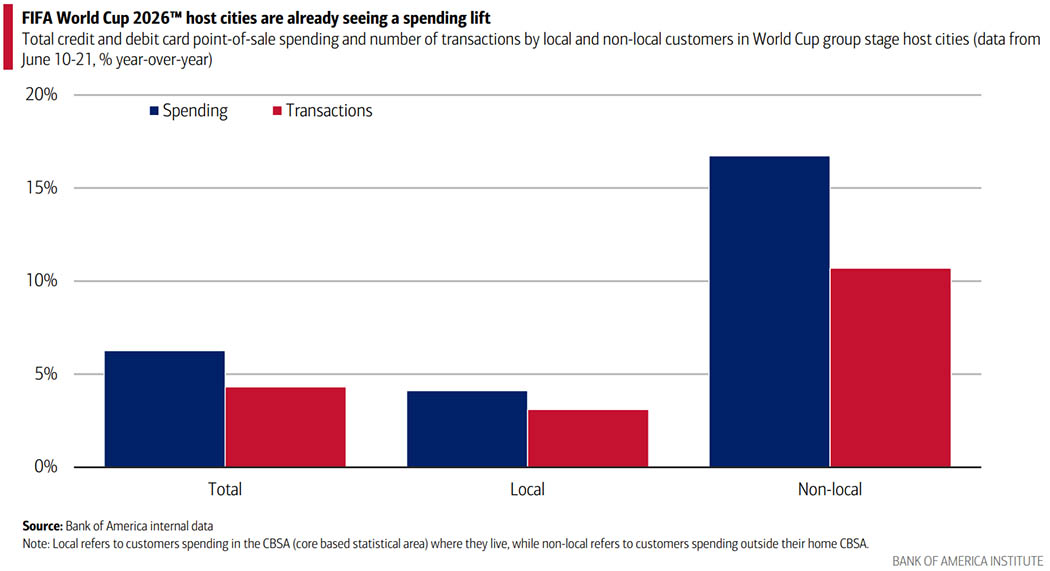
Title: FIFA World Cup 2026™ host cities are already seeing a spending lift
Total credit and debit card point-of-sale spending and number of transactions by local and non-local customers in World Cup group stage host cities (data from June 10-21, percent year-over-year)
This is a bar chart illustrating total credit and debit card spending and number of transactions by local and non-local residents in World Cup group stage host cities. There are three groups of bars: total, local, and non-local. For total, spending is up 6.3%. Transactions are up around 4.2%. For local, spending is up about 4.2% and transactions are up around 3%. For non-local, spending is up around 16.5% and transactions are up around 10.7%.
Source: Bank of America internal data
Note: Local refers to customers spending in the CBSA (core based statistical area) where they live, while non-local refers to customers spending outside their home CBSA.
BANK OF AMERICA INSTITUTE
With FIFA World Cup 2026™ now well into the group stage, we are beginning to see how the tournament is influencing consumer spending. To provide some measure of the potential impact, we examine credit and debit card in-person spending, as well as the number of transactions, across host cities using Bank of America aggregated credit and debit card data.
What do we find? The tournament appears to be off to a strong start: in host cities, overall spending is up six point three percent year over year. This is particularly being driven by "non-locals," as their spending is up a spectacular sixteen point seven percent. So, it’s not even halftime yet, but the tournament is already delivering an early goal for host-city economies.
Selected Bank of America transaction data is used to inform the macroeconomic views expressed in this report and should be considered in the context of other economic indicators and publicly available information. In certain instances, the data may provide directional and/or predictive value. The data used is not comprehensive; it is based on aggregated and anonymized selections of Bank of America data and may reflect a degree of selection bias and limitations on the data available.
Any payments data represents aggregated spend from United States Retail, Preferred, Small Business and Wealth Management clients with a deposit account or credit card. Aggregated spend include total credit card, debit card, ACH, wires, bill pay, business/peer-to-peer, cash, and checks.
Any household consumer deposit data based on Bank of America internal data is derived by anonymizing and aggregating data from Bank of America consumer deposit accounts in the United States and analyzing that data at a highly aggregated level. Whenever median household savings and checking balances are quoted, the data is based on a fixed cohort of households that had a consumer deposit account (checking and/or savings account) for all months from January two thousand nineteen through the most current month of data shown.
Transactions and spending associated with the FIFA World Cup two thousand twenty-six™ are based on data aggregated point-of-sale credit and debit card spending in CBSA’s (core based statistical areas) associated with tournament stadiums.
Additional information about the methodology used to aggregate the data is available upon request.
These materials have been prepared by Bank of America Institute and are provided to you for general information purposes only. To the extent these materials reference Bank of America data, such materials are not intended to be reflective or indicative of, and should not be relied upon as, the results of operations, financial conditions or performance of Bank of America. Bank of America Institute is a think tank dedicated to uncovering powerful insights that move business and society forward. Drawing on data and resources from across the bank and the world, the Institute delivers important, original perspectives on the economy, sustainability and global transformation. Unless otherwise specifically stated, any views or opinions expressed herein are solely those of Bank of America Institute and any individual authors listed, and are not the product of the B of A Global Research department or any other department of Bank of America Corporation or its affiliates and/or subsidiaries (collectively Bank of America). The views in these materials may differ from the views and opinions expressed by the B of A Global Research department or other departments or divisions of Bank of America. Information has been obtained from sources believed to be reliable, but Bank of America does not warrant its completeness or accuracy. These materials do not make any claim regarding the sustainability of any product or service. Any discussion of sustainability is limited as set out herein. Views and estimates constitute our judgment as of the date of these materials and are subject to change without notice. The views expressed herein should not be construed as individual investment advice for any particular person and are not intended as recommendations of particular securities, financial instruments, strategies or banking services for a particular person. This material does not constitute an offer or an invitation by or on behalf of Bank of America to any person to buy or sell any security or financial instrument or engage in any banking service. Nothing in these materials constitutes investment, legal, accounting or tax advice.
Copyright two thousand twenty-six Bank of America Corporation. All rights reserved.


.jpg/_jcr_content/renditions/original)