September 3, 2025 at 8:00 AM Eastern
BofA Report: Percentage of Workers Seeking Near-Term Financial Guidance from Employers Doubles
Employees Looking for More Employer Resources on Financial Wellness, Emergency Savings and Debt
CHARLOTTE, North Carolina – While nearly 7 in 10 employees (sixty eight percent) remain optimistic about their financial future over the next three years, many are seeking advice around both long-term savings and managing their personal finances today. This, combined with higher living costs and persistent inflation, is causing more workers to look for help prioritizing all their financial needs at once.
Twice as many American workers today are looking to their employers for guidance and resources around near-term financial needs, compared to two years ago. According to Bank of America’s twenty twenty five Workplace Benefits Report (PDF), conducted in partnership with Bank of America Institute, twenty six percent of the workforce is seeking help in areas such as emergency savings, paying down debt, and overall financial wellness, compared to thirteen percent in twenty twenty three.
“The modern employee wants help with their broader financial goals,” said Lorna Sabbia, Head of Workplace Benefits at Bank of America. “Employers should consider additional resources to support their workforce in ways that bolster their long-term goals while also helping them tackle short-term challenges.”
Other areas where employees say they need financial wellness resources include retirement education and planning (thirty six percent), learning how to generate income in retirement (thirty three percent), and developing good financial skills and habits (thirty three percent).
Based on nationwide surveys of nearly 1,000 employees and 800 employers, the 15th annual Workplace Benefits Report explores employee financial well-being and retirement preparedness, the state of workplace benefits, and more.
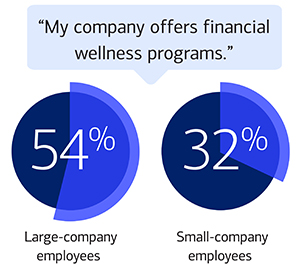
Findings show that financial wellness benefits continue to matter to employees and employers, with more than 8 in 10 employers saying that financial wellness resources help drive job satisfaction, productivity, the ability to attract top talent, and be recommended as a great place to work. However, roughly half of larger employers (fifty four percent) offer financial wellness programs – and just a third (thirty two percent) of smaller companies.
The survey also found that workplace benefits are increasingly a factor in retaining talent, with nearly a quarter (twenty four percent) of employees today saying they recently left or have considered leaving their company because their workplace benefits are lacking, up from fifteen percent in twenty twenty three.
"My company offers financial wellness programs."
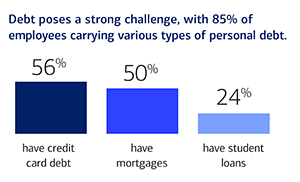
Debt poses a strong challnge, with 85% of employees carrying various types of personal debt.
Additional findings from the report include:
“Some companies are evolving their financial benefits to keep up with the needs of their employees, while others remain focused on traditional benefits alone – such as retirement plans and health insurance,” said Kai Walker, Head of Retirement Research and Insights at Bank of America. “Financial wellness programs, equity awards, debt assistance, caregiver support can all help attract and retain top talent.”
Escalent surveyed a national sample of 962 employees who are working full-time and participate in four oh one K plans, and 800 employers who offer both a four oh one K plan and have sole or shared responsibility for decisions made in the plan. The survey was conducted between December second, twenty twenty four, and January thirteenth, twenty twenty five. After the original research was complete, we complemented our annual study with an employee-focused supplemental survey conducted between April tenth and May first, twenty twenty five. This survey consisted of 508 employees working full-time and participating in four oh one K plans. The mid-year touchpoint allowed us to better measure the direct impact of current market conditions on employee feelings of financial wellness. To qualify for the survey, employees had to be current participants of a four oh one K plan and employers had to offer a four oh one K plan option. Neither was required to work with Bank of America. Bank of America was not identified as the sponsor of the study.
Bank of America Institute is dedicated to uncovering powerful insights that move business and society forward. Established in twenty twenty two, the Institute is a think tank that draws on data and analyses from across the bank and the world to provide timely and original perspectives on the economy, sustainability, and global transformation. The Institute leverages the depth and breadth of the bank’s proprietary data, from approximately 68 million consumer and small business clients, 56 million verified digital users, four point two trillion dollars in total payments in twenty twenty two and one point four trillion dollars in consumer and wealth management deposits. From this robust data set, the Institute provides a unique perspective on the health of the economy. It also elevates thought leadership from throughout the bank that addresses long-term trends and shares these findings with the general public.
Bank of America is one of the world’s leading financial institutions, serving individual consumers, small and middle-market businesses and large corporations with a full range of banking, investing, asset management and other financial and risk management products and services. The company provides unmatched convenience in the United States, serving approximately 69 million consumer and small business clients with approximately 3,700 retail financial centers, approximately 15,000 A T Ms (automated teller machines) and award-winning digital banking with approximately 59 million verified digital users. Bank of America is a global leader in wealth management, corporate and investment banking and trading across a broad range of asset classes, serving corporations, governments, institutions and individuals around the world. Bank of America offers industry-leading support to approximately 4 million small business households through a suite of innovative, easy-to-use online products and services. The company serves clients through operations across the United States, its territories and more than 35 countries. Bank of America Corporation stock is listed on the New York Stock Exchange (N Y S E B A C).
Don Vecchiarello, Bank of America
Phone: one nine eight zero three eight seven four eight nine nine
don.vecchiarello@bofa.com
MAP #8325851
Bank of America is a marketing name for the Retirement Services business of Bank of America Corporation (“B of A Corp.”). Banking activities may be performed by wholly owned banking affiliates of B of A Corp., including Bank of America, N A, Member F D I C. Brokerage and Investment advisory services are provided by wholly owned non-bank affiliates of B of A Corp., including M L P F and S, a dually registered broker-dealer and investment adviser and Member S I P C.
Investment products
| Are Not FDIC Insured | Are Not Bank Guaranteed | May Lose Value |
© twenty twenty five Bank of America Corporation. All rights reserved.
September 3, 2025 at 8:00 AM Eastern
BofA Report: Percentage of Workers Seeking Near-Term Financial Guidance from Employers Doubles
Employees Looking for More Employer Resources on Financial Wellness, Emergency Savings and Debt
CHARLOTTE, North Carolina – While nearly 7 in 10 employees (sixty eight percent) remain optimistic about their financial future over the next three years, many are seeking advice around both long-term savings and managing their personal finances today. This, combined with higher living costs and persistent inflation, is causing more workers to look for help prioritizing all their financial needs at once.
Twice as many American workers today are looking to their employers for guidance and resources around near-term financial needs, compared to two years ago. According to Bank of America’s twenty twenty five Workplace Benefits Report (PDF), conducted in partnership with Bank of America Institute, twenty six percent of the workforce is seeking help in areas such as emergency savings, paying down debt, and overall financial wellness, compared to thirteen percent in twenty twenty three.
“The modern employee wants help with their broader financial goals,” said Lorna Sabbia, Head of Workplace Benefits at Bank of America. “Employers should consider additional resources to support their workforce in ways that bolster their long-term goals while also helping them tackle short-term challenges.”
Other areas where employees say they need financial wellness resources include retirement education and planning (thirty six percent), learning how to generate income in retirement (thirty three percent), and developing good financial skills and habits (thirty three percent).
Based on nationwide surveys of nearly 1,000 employees and 800 employers, the 15th annual Workplace Benefits Report explores employee financial well-being and retirement preparedness, the state of workplace benefits, and more.
Findings show that financial wellness benefits continue to matter to employees and employers, with more than 8 in 10 employers saying that financial wellness resources help drive job satisfaction, productivity, the ability to attract top talent, and be recommended as a great place to work. However, roughly half of larger employers (fifty four percent) offer financial wellness programs – and just a third (thirty two percent) of smaller companies.
The survey also found that workplace benefits are increasingly a factor in retaining talent, with nearly a quarter (twenty four percent) of employees today saying they recently left or have considered leaving their company because their workplace benefits are lacking, up from fifteen percent in twenty twenty three.
"My company offers financial wellness programs."
Debt poses a strong challnge, with 85% of employees carrying various types of personal debt.
Additional findings from the report include:
“Some companies are evolving their financial benefits to keep up with the needs of their employees, while others remain focused on traditional benefits alone – such as retirement plans and health insurance,” said Kai Walker, Head of Retirement Research and Insights at Bank of America. “Financial wellness programs, equity awards, debt assistance, caregiver support can all help attract and retain top talent.”
Escalent surveyed a national sample of 962 employees who are working full-time and participate in four oh one K plans, and 800 employers who offer both a four oh one K plan and have sole or shared responsibility for decisions made in the plan. The survey was conducted between December second, twenty twenty four, and January thirteenth, twenty twenty five. After the original research was complete, we complemented our annual study with an employee-focused supplemental survey conducted between April tenth and May first, twenty twenty five. This survey consisted of 508 employees working full-time and participating in four oh one K plans. The mid-year touchpoint allowed us to better measure the direct impact of current market conditions on employee feelings of financial wellness. To qualify for the survey, employees had to be current participants of a four oh one K plan and employers had to offer a four oh one K plan option. Neither was required to work with Bank of America. Bank of America was not identified as the sponsor of the study.
Bank of America Institute is dedicated to uncovering powerful insights that move business and society forward. Established in twenty twenty two, the Institute is a think tank that draws on data and analyses from across the bank and the world to provide timely and original perspectives on the economy, sustainability, and global transformation. The Institute leverages the depth and breadth of the bank’s proprietary data, from approximately 68 million consumer and small business clients, 56 million verified digital users, four point two trillion dollars in total payments in twenty twenty two and one point four trillion dollars in consumer and wealth management deposits. From this robust data set, the Institute provides a unique perspective on the health of the economy. It also elevates thought leadership from throughout the bank that addresses long-term trends and shares these findings with the general public.
Bank of America is one of the world’s leading financial institutions, serving individual consumers, small and middle-market businesses and large corporations with a full range of banking, investing, asset management and other financial and risk management products and services. The company provides unmatched convenience in the United States, serving approximately 69 million consumer and small business clients with approximately 3,700 retail financial centers, approximately 15,000 A T Ms (automated teller machines) and award-winning digital banking with approximately 59 million verified digital users. Bank of America is a global leader in wealth management, corporate and investment banking and trading across a broad range of asset classes, serving corporations, governments, institutions and individuals around the world. Bank of America offers industry-leading support to approximately 4 million small business households through a suite of innovative, easy-to-use online products and services. The company serves clients through operations across the United States, its territories and more than 35 countries. Bank of America Corporation stock is listed on the New York Stock Exchange (N Y S E B A C).
Don Vecchiarello, Bank of America
Phone: one nine eight zero three eight seven four eight nine nine
don.vecchiarello@bofa.com
MAP #8325851
Bank of America is a marketing name for the Retirement Services business of Bank of America Corporation (“B of A Corp.”). Banking activities may be performed by wholly owned banking affiliates of B of A Corp., including Bank of America, N A, Member F D I C. Brokerage and Investment advisory services are provided by wholly owned non-bank affiliates of B of A Corp., including M L P F and S, a dually registered broker-dealer and investment adviser and Member S I P C.
Investment products
| Are Not FDIC Insured | Are Not Bank Guaranteed | May Lose Value |
© twenty twenty five Bank of America Corporation. All rights reserved.


.jpg/_jcr_content/renditions/original)