June 17, 2026 at 9:00 AM Eastern
BofA Study Finds Longevity and Accelerating Wealth Transfer Are Making Family Finances More Complex
Longer lives, more businesses being passed down, and an interest in alternative investments are reshaping how wealthy individuals plan and invest
NEW YORK, New York – The 2026 Bank of America Private Bank Study of Wealthy Americans, surveying individuals with three million dollars or more in investable assets, finds that longer lifespans, accelerating family business transitions and shifting investment preferences are reshaping financial priorities. More than ninety percent cite longevity as a critical planning consideration, while nearly one quarter of business owners report inheriting their companies, highlighting the speed at which multigenerational complexity is emerging.
“The Great Wealth Transfer is not simply a transfer of assets, it represents a meaningful shift in how clients define and engage with their wealth,” said Katy Knox, President of Bank of America Private Bank. “As financial lives become increasingly complex, clients are looking for thoughtful, personalized strategies that bring together investing, credit, banking, and legacy planning in a more integrated and purposeful way.”
Longer lives are raising expectations for lasting wealth, but planning has yet to fully catch up.
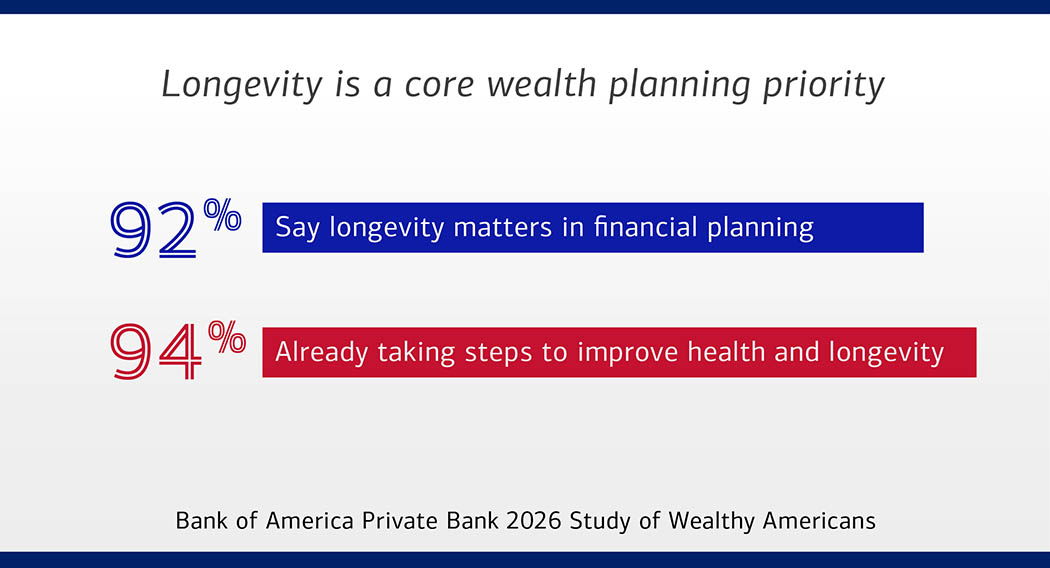
Longevity is a core wealth planning priority
Bank of America Private Bank 2026 Study of Wealthy Americans
Business ownership plays an increasingly central role in wealth transfer despite gaps in formal succession planning.
Ultra-high-net-worth (UHNW) investors with over twenty five million dollars in investable assets are increasingly focused on private markets, strategic use of credit, and intentional planning to preserve wealth across generations.
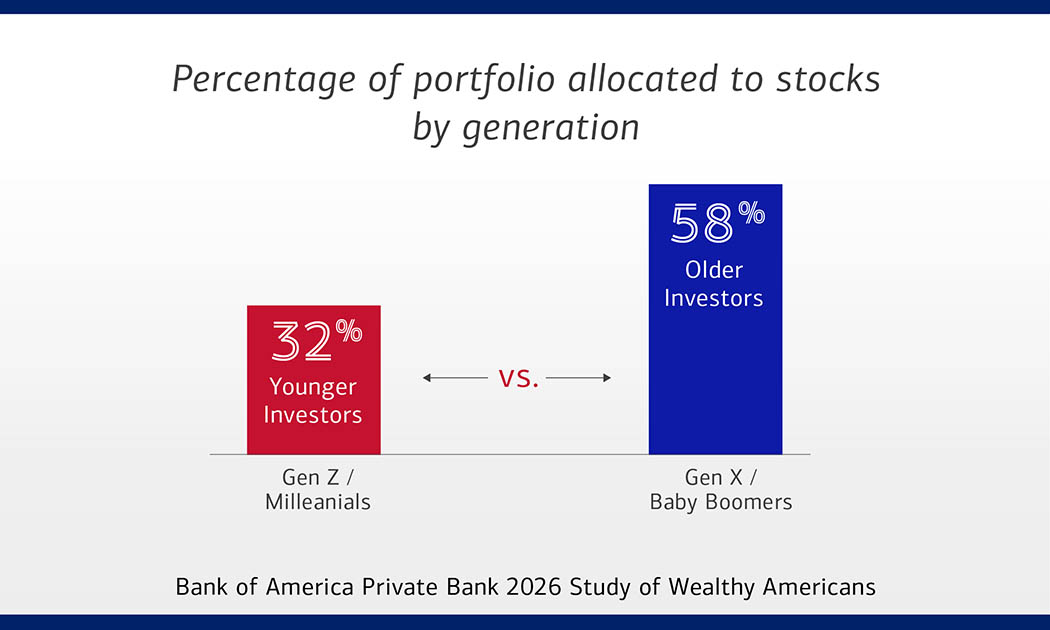
Younger investors (Gen Z and Millennials, ages 21 to 45) are reshaping how wealth is built and diversified, as they embrace alternative investments and emerging technologies.
Percentage of portfolio allocated to socks by generation
Bank of America Private Bank 2026 Study of Wealthy Americans
Read more about the 2026 Bank of America Private Bank Study of Wealthy Americans.
Answer: Bank of America Private Bank delivers integrated wealth management built for complexity by bringing together solutions spanning wealth strategy, trust and estate planning, investment management, banking, specialty lending, and philanthropy. Advisors, support by award-winning digital platforms, work across disciplines, to help clients manage growth, liquidity, longevity, and legacy as their priorities evolve.
Answer: Bank of America Private Bank helps families plan for longevity and wealth transfer through trust and estate planning, business succession strategies, and family education. Advisors facilitate conversations across generations to align financial plans with family values, helping clients preserve wealth, prepare heirs, and plan for extended lifespans.
Answer: The Private Bank offers access to a broad range of alternative investment strategies, including private equity, real estate, and select opportunistic investments, alongside traditional portfolios. Advisors help clients evaluate where alternatives fit within an individual client’s overall asset allocation, balancing risk tolerance, liquidity needs, and long‑term objectives.
Answer: Advisors work with clients to use credit strategically, whether to manage liquidity, finance major lifestyle purchases, support business opportunities, or preserve investment positions, while aligning borrowing decisions with long‑term wealth goals.
Answer: Bank of America Private Bank uses AI to support advisor capacity, deepen client relationships, and help teams find information faster and more efficiently. In 2025, ninety three percent of Private Bank clients were digitally active, reflecting strong adoption of our digital banking tools.
Escalent, an independent market research company, conducted an online survey on behalf of Bank of America Private Bank among 1,431 wealthy individuals in the United States. Respondents were ages 21 or older with at least three million dollars in investable assets, excluding primary residence. Participants were sourced from multiple panel providers targeting wealthy individuals. The survey was fielded from January 8, 2026, to February 5, 2026. Data were weighted to reflect the U.S. high‑net‑worth population by age, investable assets, region, and gender, and respondents are not necessarily clients of Bank of America or its wealth and investment management businesses.
Bank of America is one of the world’s leading financial institutions, serving individual consumers, small and middle-market businesses and large corporations with a full range of banking, investing, asset management and other financial and risk management products and services. The company provides unmatched convenience in the United States, serving nearly 70 million clients with approximately 3,500 retail financial centers, approximately 15,000 ATMs (automated teller machines) and award-winning digital banking with approximately 59 million verified digital users. Bank of America is a global leader in wealth management, corporate and investment banking and trading across a broad range of asset classes, serving corporations, governments, institutions and individuals around the world. As the #1 small business lender in the United States (FDIC), Bank of America offers industry leading support to approximately 4 million small business households through a suite of innovative, easy-to-use online products and services. The company serves clients through operations across the United States, its territories and more than 35 countries. Bank of America Corporation stock (NYSE: BAC) is listed on the New York Stock Exchange.
Julia Ehrenfeld, Bank of America
Phone:1 9 8 0 3 8 7 0 5 1 4
julia.ehrenfeld@bofa.com
Carolyn Batt, Bank of America
Phone:1 6 4 6 9 8 3 1 3 6 9
carolyn.batt@bofa.com
MAP #8971085
Bank of America Corporation (“Bank of America”) is a financial holding company that, through its subsidiaries and affiliated companies, provides banking and non-banking financial services.
Bank of America Private Bank is a division of Bank of America, N.A., Member FDIC and a wholly owned subsidiary of Bank of America Corporation (“BofA Corp.”).
Bank of America, N.A., and U.S. Trust Company of Delaware (collectively the “Bank”) do not serve in a fiduciary capacity with respect to all products or services. Fiduciary standards or fiduciary duties do not apply, for example, when the Bank is offering or providing credit solutions, banking, custody or brokerage products/services or referrals to other affiliates of the Bank.
Banking products are provided by Bank of America, N.A., and affiliated banks, Members FDIC and wholly owned subsidiaries of Bank of America Corporation.
Investing involves risk including possible loss of principal. Past performance is no guarantee of future results.
Credit and collateral subject to approval. Terms and conditions apply. Programs, rates, terms and conditions subject to change without notice.
Bank of America and its affiliates do not provide legal, tax or accounting advice. You should consult your legal and/or tax advisors before making any financial decisions.
Investment products:
| Are Not FDIC Insured | Are Not Bank Guaranteed | May Lose Value |
©2026 Bank of America Corporation.
June 17, 2026 at 9:00 AM Eastern
BofA Study Finds Longevity and Accelerating Wealth Transfer Are Making Family Finances More Complex
Longer lives, more businesses being passed down, and an interest in alternative investments are reshaping how wealthy individuals plan and invest
NEW YORK, New York – The 2026 Bank of America Private Bank Study of Wealthy Americans, surveying individuals with three million dollars or more in investable assets, finds that longer lifespans, accelerating family business transitions and shifting investment preferences are reshaping financial priorities. More than ninety percent cite longevity as a critical planning consideration, while nearly one quarter of business owners report inheriting their companies, highlighting the speed at which multigenerational complexity is emerging.
“The Great Wealth Transfer is not simply a transfer of assets, it represents a meaningful shift in how clients define and engage with their wealth,” said Katy Knox, President of Bank of America Private Bank. “As financial lives become increasingly complex, clients are looking for thoughtful, personalized strategies that bring together investing, credit, banking, and legacy planning in a more integrated and purposeful way.”
Longer lives are raising expectations for lasting wealth, but planning has yet to fully catch up.
Longevity is a core wealth planning priority
Bank of America Private Bank 2026 Study of Wealthy Americans
Business ownership plays an increasingly central role in wealth transfer despite gaps in formal succession planning.
Ultra-high-net-worth (UHNW) investors with over twenty five million dollars in investable assets are increasingly focused on private markets, strategic use of credit, and intentional planning to preserve wealth across generations.
Younger investors (Gen Z and Millennials, ages 21 to 45) are reshaping how wealth is built and diversified, as they embrace alternative investments and emerging technologies.
Percentage of portfolio allocated to socks by generation
Bank of America Private Bank 2026 Study of Wealthy Americans
Read more about the 2026 Bank of America Private Bank Study of Wealthy Americans.
Answer: Bank of America Private Bank delivers integrated wealth management built for complexity by bringing together solutions spanning wealth strategy, trust and estate planning, investment management, banking, specialty lending, and philanthropy. Advisors, support by award-winning digital platforms, work across disciplines, to help clients manage growth, liquidity, longevity, and legacy as their priorities evolve.
Answer: Bank of America Private Bank helps families plan for longevity and wealth transfer through trust and estate planning, business succession strategies, and family education. Advisors facilitate conversations across generations to align financial plans with family values, helping clients preserve wealth, prepare heirs, and plan for extended lifespans.
Answer: The Private Bank offers access to a broad range of alternative investment strategies, including private equity, real estate, and select opportunistic investments, alongside traditional portfolios. Advisors help clients evaluate where alternatives fit within an individual client’s overall asset allocation, balancing risk tolerance, liquidity needs, and long‑term objectives.
Answer: Advisors work with clients to use credit strategically, whether to manage liquidity, finance major lifestyle purchases, support business opportunities, or preserve investment positions, while aligning borrowing decisions with long‑term wealth goals.
Answer: Bank of America Private Bank uses AI to support advisor capacity, deepen client relationships, and help teams find information faster and more efficiently. In 2025, ninety three percent of Private Bank clients were digitally active, reflecting strong adoption of our digital banking tools.
Escalent, an independent market research company, conducted an online survey on behalf of Bank of America Private Bank among 1,431 wealthy individuals in the United States. Respondents were ages 21 or older with at least three million dollars in investable assets, excluding primary residence. Participants were sourced from multiple panel providers targeting wealthy individuals. The survey was fielded from January 8, 2026, to February 5, 2026. Data were weighted to reflect the U.S. high‑net‑worth population by age, investable assets, region, and gender, and respondents are not necessarily clients of Bank of America or its wealth and investment management businesses.
Bank of America is one of the world’s leading financial institutions, serving individual consumers, small and middle-market businesses and large corporations with a full range of banking, investing, asset management and other financial and risk management products and services. The company provides unmatched convenience in the United States, serving nearly 70 million clients with approximately 3,500 retail financial centers, approximately 15,000 ATMs (automated teller machines) and award-winning digital banking with approximately 59 million verified digital users. Bank of America is a global leader in wealth management, corporate and investment banking and trading across a broad range of asset classes, serving corporations, governments, institutions and individuals around the world. As the #1 small business lender in the United States (FDIC), Bank of America offers industry leading support to approximately 4 million small business households through a suite of innovative, easy-to-use online products and services. The company serves clients through operations across the United States, its territories and more than 35 countries. Bank of America Corporation stock (NYSE: BAC) is listed on the New York Stock Exchange.
Julia Ehrenfeld, Bank of America
Phone:1 9 8 0 3 8 7 0 5 1 4
julia.ehrenfeld@bofa.com
Carolyn Batt, Bank of America
Phone:1 6 4 6 9 8 3 1 3 6 9
carolyn.batt@bofa.com
MAP #8971085
Bank of America Corporation (“Bank of America”) is a financial holding company that, through its subsidiaries and affiliated companies, provides banking and non-banking financial services.
Bank of America Private Bank is a division of Bank of America, N.A., Member FDIC and a wholly owned subsidiary of Bank of America Corporation (“BofA Corp.”).
Bank of America, N.A., and U.S. Trust Company of Delaware (collectively the “Bank”) do not serve in a fiduciary capacity with respect to all products or services. Fiduciary standards or fiduciary duties do not apply, for example, when the Bank is offering or providing credit solutions, banking, custody or brokerage products/services or referrals to other affiliates of the Bank.
Banking products are provided by Bank of America, N.A., and affiliated banks, Members FDIC and wholly owned subsidiaries of Bank of America Corporation.
Investing involves risk including possible loss of principal. Past performance is no guarantee of future results.
Credit and collateral subject to approval. Terms and conditions apply. Programs, rates, terms and conditions subject to change without notice.
Bank of America and its affiliates do not provide legal, tax or accounting advice. You should consult your legal and/or tax advisors before making any financial decisions.
Investment products:
| Are Not FDIC Insured | Are Not Bank Guaranteed | May Lose Value |
©2026 Bank of America Corporation.


.jpg/_jcr_content/renditions/original)