July 21, 2026 at 8:30 AM Eastern
B of A Report: Financial Wellbeing of Employees at U.S. Companies Hits Four-Year High, Even as Cost-of-Living Pressures Persist
NEW YORK, New York – Bank of America today released its 2026 Workplace Benefits Report (PDF) in partnership with Bank of America Institute, revealing American workers are taking proactive steps to improve their financial wellbeing and save with greater confidence. While economic challenges remain, the report finds that workers at U.S. companies are increasingly turning to their employers to help them build long-term financial stability.
The report finds that overall employee financial wellbeing reached a four-year high of fifty five percent, an eleven point increase from twenty twenty three. This sense of wellbeing is also reflected when employees consider the future: two-thirds (sixty six percent) expressed career optimism over the next three years. However, even amid this optimism, employees say the economy (seventy six percent) and inflation (sixty two percent) cause them stress, and three-quarters (seventy five percent) cite cost of living as a challenge to their financial security.
The report also reveals a disconnect: while seventy one percent of employers rate their workforce's financial wellbeing as good or excellent, only fifty five percent of employees agree, indicating employers are underestimating the day-to-day financial struggles of their workforce.
"We’re seeing real progress for American workers as overall financial wellness steadily rebounds to a four-year high," said Stacy Bucchere, Managing Director of Workplace Benefits Client Management at Bank of America. "However, employees are still navigating complex financial circumstances that require proactive support from employers to help build long-term stability."
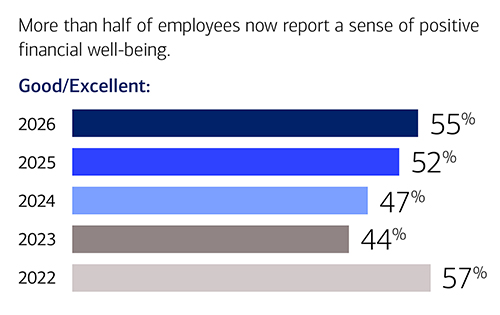
Bar graph titled: More than half of employees now report a sense of positive financial well-being.
Sub head: Good/Excellent
First bar is twenty twenty six, fifty five percent; Second bar is twenty twenty five, fifty two percent; Third bar is twenty twenty four, forty seven percent; Fourth bar is twenty twenty three, forty four percent; Fifth bar is twenty twenty two, fifty seven percent.
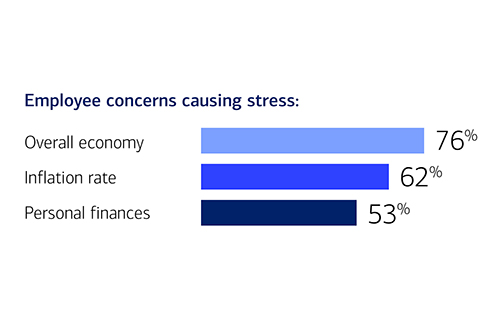
Bar graph titled: Employee concerns causing stress
First bar is Overall economy, seventy six percent; Second bar is Inflation rate, sixty two percent; Third bar is Personal finances, fifty three percent.
“Saving for retirement remains a top priority for American workers, and more are feeling on track toward their retirement savings goals,” said Kai Walker, Managing Director of Workplace Benefits Research. “Perhaps most encouraging is that the youngest generation in the workforce is starting to save for retirement a full decade earlier than their older peers.”
The report’s findings show that:
The report also uncovered an underutilized savings opportunity for many employees. While more than 6 in 10 employers currently offer a healthcare plan with access to a H S A – and more than eighty percent of employees with access to an H S A actively contribute – nearly half of participants are making regular withdrawals rather than investing or saving the funds for the future.
Though saving for retirement remains a top priority for American workers, employees are also working toward short-term financial goals, including building emergency savings, which is a top priority for forty four percent of workers. Nearly sixty percent of employees say they have hit their emergency savings goal in 2026 – a ten point increase when compared to twenty twenty five.
Employees have also made progress on paying down debt. Stress around debt has decreased six point since twenty twenty five, and the percentage of employees who say they have credit card debt is now forty five percent, down eleven point since last year. Even with these gains, employees are looking at employers to support them with debt management: the report indicates almost 1 in 3 employees say that having a financial advisor to help them create a personalized debt management plan would be valuable.
As the labor market remains highly competitive in twenty twenty six, employee retention is a top business priority. The report indicates that more than 1 in 3 employees have left or considered leaving their job in the past year.
Comprehensive benefits packages are proving to be a competitive advantage:
"These findings demonstrate the mutual value of financial wellness programs to both employees and employers," said John Quinn, Managing Director of Workplace Benefits Product & Platform Management at Bank of America. "In today’s labor market, workplace benefits are no longer just a recruitment checklist item; they’re a key to stronger workforces. This is especially true for small businesses that report having a harder time engaging top talent. A strong benefits offering can help even the playing field.”
The report found that many employers are not yet leveraging emerging technology like A I to assess and enhance benefits offerings. While eighty seven percent of employers report using A I, only fifty two percent use it for benefits administration, and just thirty five percent use it to track benefits usage and engagement.
Answer: The full 2026 Workplace Benefits Report (PDF) can be found in the Bank of America Newsroom.
Answer: Bank of America Workplace Benefits provides guidance and solutions that help businesses support their employees' short- and long-term goals. Our dedicated team of experts has years of experience and supports companies with plan selection, setup and ongoing maintenance, making the process seamless for plan sponsors.
Answer: Through retirement and benefit plans [1], health benefit accounts[2], employee banking solutions [2], stock plan services[1] and more, seamlessly integrated across its full set of financial capabilities, employees have a more holistic view of their financial lives, so they get the benefits most relevant to what they need today and aligned to their goals for tomorrow.
Escalent surveyed a national sample of 941 employees who are working full-time and participate in four oh one k plans, and 806 employers who offer both a four oh one k plan and have sole or shared responsibility for decisions made in the plan. The survey was conducted between December 4, twenty twenty five, and January 26, twenty twenty six. To qualify, employees had to be current participants in a four oh one k plan, and employers had to offer a four oh one k plan option. Neither was required to work with Bank of America, which was not identified as the sponsor of the study.
Bank of America Institute is dedicated to uncovering powerful insights that move business and society forward. Established in twenty twenty two, the Institute is a think tank that draws on data and analyses from across the bank and the world to provide timely and original perspectives on the economy, sustainability, and global transformation. The Institute leverages the depth and breadth of the bank’s proprietary data, from nearly 70 million consumer and small business clients, four point five two trillion dollars in total payments in twenty twenty five and one point two trillion dollars in consumer and wealth management deposits. From this robust data set, the Institute provides a unique perspective on the health of the economy. It also elevates thought leadership from throughout the bank that addresses long-term trends and shares these findings with the general public.
Bank of America is one of the world’s leading financial institutions, serving individual consumers, small and middle-market businesses and large corporations with a full range of banking, investing, asset management and other financial and risk management products and services. The company provides unmatched convenience in the United States, serving nearly 70 million clients with approximately 3,500 retail financial centers, approximately 15,000 A T Ms (automated teller machines) and award-winning digital banking with approximately 60 million verified digital users. Bank of America is a global leader in wealth management, corporate and investment banking and trading across a broad range of asset classes, serving corporations, governments, institutions and individuals around the world. As the #1 small business lender in the United States (F D I C), Bank of America offers industry leading support to approximately 4 million small business households through a suite of innovative, easy-to-use online products and services. The company serves clients through operations across the United States, its territories and more than 35 countries and/or jurisdictions. Bank of America Corporation stock (N Y S E B A C) is listed on the New York Stock Exchange.
Workplace Benefits is the institutional retirement and benefits business of Bank of America Corporation (“B of A Corp.”) operating under the name “Bank of America.” Investment advisory and brokerage services are provided by wholly owned non-bank affiliates of B of A Corp., including Merrill Lynch Pierce, Fenner & Smith Incorporated (also referred to as “M L P F and S” or “Merrill”), a dually registered broker-dealer and investment adviser and Member S I P C. Banking activities may be performed by wholly owned banking affiliates of B of A Corp., including Bank of America, N A, Member F D I C.
Visit BofA Fast Facts for more information about the company.
Anu Ahluwalia, Bank of America
Phone: one six four six eight five five three three seven five
anu.ahluwalia@bofa.com
MAP# 9016405
Investment products
| Are Not FDIC Insured | Are Not Bank Guaranteed | May Lose Value |
[1] Investment products are available from Merrill Lynch, Pierce, Fenner & Smith Incorporated.
[2] Bank products are available from Bank of America, N A, and affiliated banks.
July 21, 2026 at 8:30 AM Eastern
B of A Report: Financial Wellbeing of Employees at U.S. Companies Hits Four-Year High, Even as Cost-of-Living Pressures Persist
NEW YORK, New York – Bank of America today released its 2026 Workplace Benefits Report (PDF) in partnership with Bank of America Institute, revealing American workers are taking proactive steps to improve their financial wellbeing and save with greater confidence. While economic challenges remain, the report finds that workers at U.S. companies are increasingly turning to their employers to help them build long-term financial stability.
The report finds that overall employee financial wellbeing reached a four-year high of fifty five percent, an eleven point increase from twenty twenty three. This sense of wellbeing is also reflected when employees consider the future: two-thirds (sixty six percent) expressed career optimism over the next three years. However, even amid this optimism, employees say the economy (seventy six percent) and inflation (sixty two percent) cause them stress, and three-quarters (seventy five percent) cite cost of living as a challenge to their financial security.
The report also reveals a disconnect: while seventy one percent of employers rate their workforce's financial wellbeing as good or excellent, only fifty five percent of employees agree, indicating employers are underestimating the day-to-day financial struggles of their workforce.
"We’re seeing real progress for American workers as overall financial wellness steadily rebounds to a four-year high," said Stacy Bucchere, Managing Director of Workplace Benefits Client Management at Bank of America. "However, employees are still navigating complex financial circumstances that require proactive support from employers to help build long-term stability."
Bar graph titled: More than half of employees now report a sense of positive financial well-being.
Sub head: Good/Excellent
First bar is twenty twenty six, fifty five percent; Second bar is twenty twenty five, fifty two percent; Third bar is twenty twenty four, forty seven percent; Fourth bar is twenty twenty three, forty four percent; Fifth bar is twenty twenty two, fifty seven percent.
Bar graph titled: Employee concerns causing stress
First bar is Overall economy, seventy six percent; Second bar is Inflation rate, sixty two percent; Third bar is Personal finances, fifty three percent.
“Saving for retirement remains a top priority for American workers, and more are feeling on track toward their retirement savings goals,” said Kai Walker, Managing Director of Workplace Benefits Research. “Perhaps most encouraging is that the youngest generation in the workforce is starting to save for retirement a full decade earlier than their older peers.”
The report’s findings show that:
The report also uncovered an underutilized savings opportunity for many employees. While more than 6 in 10 employers currently offer a healthcare plan with access to a H S A – and more than eighty percent of employees with access to an H S A actively contribute – nearly half of participants are making regular withdrawals rather than investing or saving the funds for the future.
Though saving for retirement remains a top priority for American workers, employees are also working toward short-term financial goals, including building emergency savings, which is a top priority for forty four percent of workers. Nearly sixty percent of employees say they have hit their emergency savings goal in 2026 – a ten point increase when compared to twenty twenty five.
Employees have also made progress on paying down debt. Stress around debt has decreased six point since twenty twenty five, and the percentage of employees who say they have credit card debt is now forty five percent, down eleven point since last year. Even with these gains, employees are looking at employers to support them with debt management: the report indicates almost 1 in 3 employees say that having a financial advisor to help them create a personalized debt management plan would be valuable.
As the labor market remains highly competitive in twenty twenty six, employee retention is a top business priority. The report indicates that more than 1 in 3 employees have left or considered leaving their job in the past year.
Comprehensive benefits packages are proving to be a competitive advantage:
"These findings demonstrate the mutual value of financial wellness programs to both employees and employers," said John Quinn, Managing Director of Workplace Benefits Product & Platform Management at Bank of America. "In today’s labor market, workplace benefits are no longer just a recruitment checklist item; they’re a key to stronger workforces. This is especially true for small businesses that report having a harder time engaging top talent. A strong benefits offering can help even the playing field.”
The report found that many employers are not yet leveraging emerging technology like A I to assess and enhance benefits offerings. While eighty seven percent of employers report using A I, only fifty two percent use it for benefits administration, and just thirty five percent use it to track benefits usage and engagement.
Answer: The full 2026 Workplace Benefits Report (PDF) can be found in the Bank of America Newsroom.
Answer: Bank of America Workplace Benefits provides guidance and solutions that help businesses support their employees' short- and long-term goals. Our dedicated team of experts has years of experience and supports companies with plan selection, setup and ongoing maintenance, making the process seamless for plan sponsors.
Answer: Through retirement and benefit plans [1], health benefit accounts[2], employee banking solutions [2], stock plan services[1] and more, seamlessly integrated across its full set of financial capabilities, employees have a more holistic view of their financial lives, so they get the benefits most relevant to what they need today and aligned to their goals for tomorrow.
Escalent surveyed a national sample of 941 employees who are working full-time and participate in four oh one k plans, and 806 employers who offer both a four oh one k plan and have sole or shared responsibility for decisions made in the plan. The survey was conducted between December 4, twenty twenty five, and January 26, twenty twenty six. To qualify, employees had to be current participants in a four oh one k plan, and employers had to offer a four oh one k plan option. Neither was required to work with Bank of America, which was not identified as the sponsor of the study.
Bank of America Institute is dedicated to uncovering powerful insights that move business and society forward. Established in twenty twenty two, the Institute is a think tank that draws on data and analyses from across the bank and the world to provide timely and original perspectives on the economy, sustainability, and global transformation. The Institute leverages the depth and breadth of the bank’s proprietary data, from nearly 70 million consumer and small business clients, four point five two trillion dollars in total payments in twenty twenty five and one point two trillion dollars in consumer and wealth management deposits. From this robust data set, the Institute provides a unique perspective on the health of the economy. It also elevates thought leadership from throughout the bank that addresses long-term trends and shares these findings with the general public.
Bank of America is one of the world’s leading financial institutions, serving individual consumers, small and middle-market businesses and large corporations with a full range of banking, investing, asset management and other financial and risk management products and services. The company provides unmatched convenience in the United States, serving nearly 70 million clients with approximately 3,500 retail financial centers, approximately 15,000 A T Ms (automated teller machines) and award-winning digital banking with approximately 60 million verified digital users. Bank of America is a global leader in wealth management, corporate and investment banking and trading across a broad range of asset classes, serving corporations, governments, institutions and individuals around the world. As the #1 small business lender in the United States (F D I C), Bank of America offers industry leading support to approximately 4 million small business households through a suite of innovative, easy-to-use online products and services. The company serves clients through operations across the United States, its territories and more than 35 countries and/or jurisdictions. Bank of America Corporation stock (N Y S E B A C) is listed on the New York Stock Exchange.
Workplace Benefits is the institutional retirement and benefits business of Bank of America Corporation (“B of A Corp.”) operating under the name “Bank of America.” Investment advisory and brokerage services are provided by wholly owned non-bank affiliates of B of A Corp., including Merrill Lynch Pierce, Fenner & Smith Incorporated (also referred to as “M L P F and S” or “Merrill”), a dually registered broker-dealer and investment adviser and Member S I P C. Banking activities may be performed by wholly owned banking affiliates of B of A Corp., including Bank of America, N A, Member F D I C.
Visit BofA Fast Facts for more information about the company.
Anu Ahluwalia, Bank of America
Phone: one six four six eight five five three three seven five
anu.ahluwalia@bofa.com
MAP# 9016405
Investment products
| Are Not FDIC Insured | Are Not Bank Guaranteed | May Lose Value |
[1] Investment products are available from Merrill Lynch, Pierce, Fenner & Smith Incorporated.
[2] Bank products are available from Bank of America, N A, and affiliated banks.


.jpg/_jcr_content/renditions/original)


